Description
Product Details
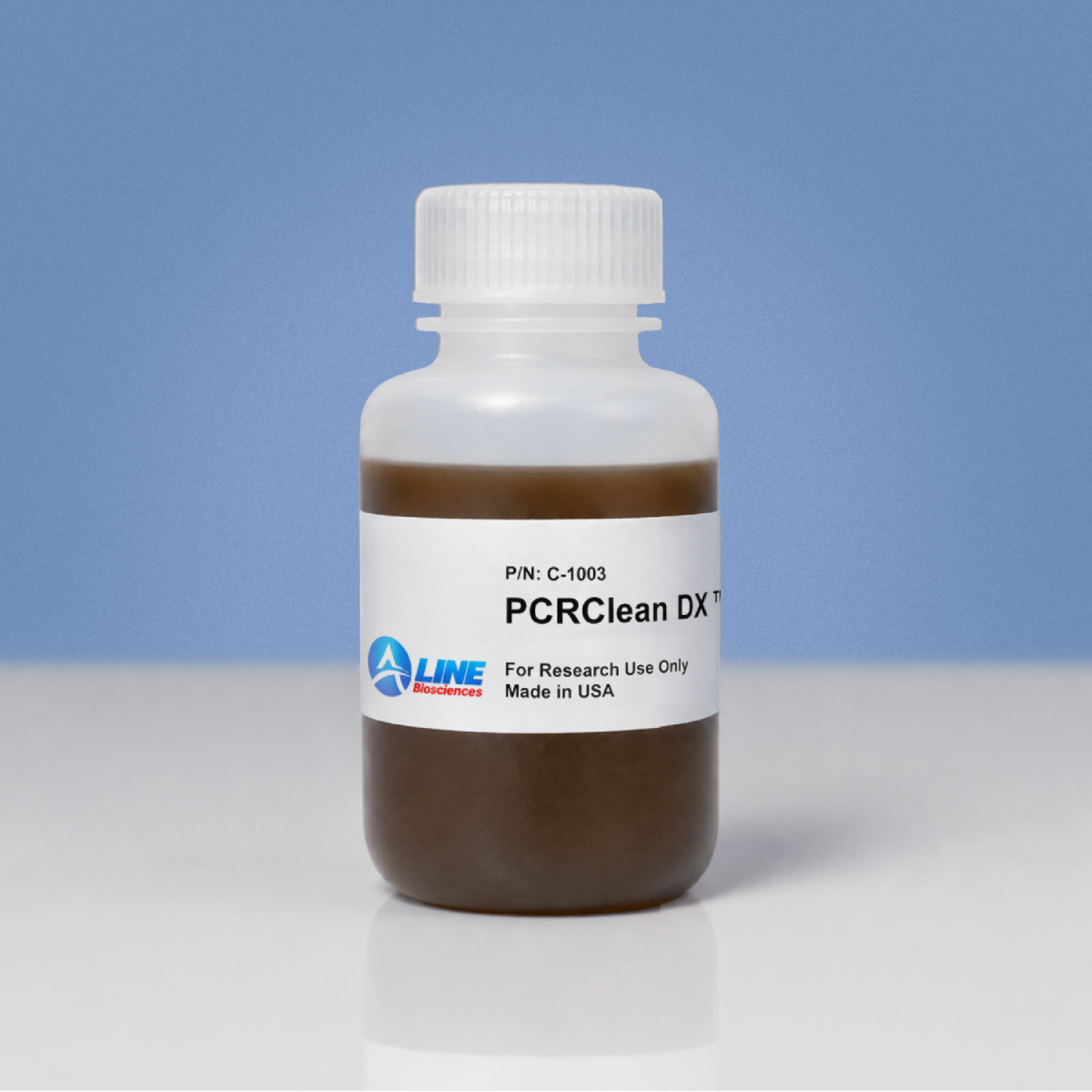
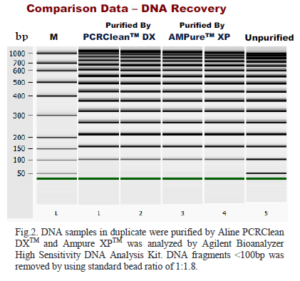
The PCRClean DX purification system utilizes Aline’s proprietary paramagnetic bead technology for the rapid, high-throughput purification of DNA fragments. Engineered for consistency, the system delivers consistent recovery efficiencies for both small and large amplicons that exceed those of traditional filtration-based PCR cleanup methods.
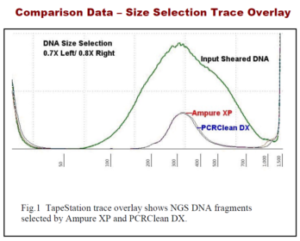
As a direct replacement for Beckman Coulter and Agencourt’s AMPure® XP, PCRClean DX requires zero protocol changes while delivering superior adapter and primer-dimer removal, allowing labs to maintain existing workflows yet achieve enhanced purification efficiency for NGS library prep.
Key Features
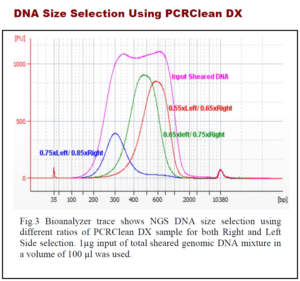
- Flexible clean-up: high recovery of amplicons with option to choose recovery of >100 bp or >60 bp with modified protocol
- Efficient removal of unincorporated dNTPs, primers, primer dimers, salts and other contaminants
- Processing time: 15 minutes/96 samples
- Scalable: suitable for tube, 96 and 384-well plate formats
- Compatible with all next generation sequencing platforms (e.g., Illumina, Ion Torrent)
Applications
- Sanger sequencing post-PCR cleanup
- Genotyping and mutation detection
- DNA Enriching/Concentrating
- Primer Walking
- All other downstream molecular engineering
Datasheet
For download: Click here
Sizes:
- 5 mL, 500 - 1,000 preps
- 50 mL, 5,000 - 10,000 preps
- 250mL, 25,000 - 50,000 preps
- 450 mL, 45,000 - 90,000 preps
Storage:
- Store beads at 2-8°C, DO NOT FREEZE
- Store all other components at 15-25°C
Stability:
- 12 months if stored as specified
Disclaimer: For research use only. Not for use in diagnostic procedures.
Protocol
Protocol is exchangeable with that of Ampure XP. No procedure changes needed if you have been using Ampure XP.
Protocol-PCRClean DX.pdf
Safety Data Sheet
PCRClean DX MSDS.pdf
Data Sheet
PCRClean DX Datasheet.pdf
Product References in Journal Publications
- Cheng, E. C. K., et al., EMBO reports, 26(7), 1891–1912. (2025). Cytosolic CRISPR RNAs for efficient application of RNA-targeting CRISPR-Cas systems.
https://doi.org/10.1038/s44319-025-00399-4
- Allen, J. L., et al. Microbiology resource announcements, 10(44), e0068621. (2021). Draft Genome Sequence of the Lichenized Fungus Bacidia gigantensis.
https://doi.org/10.1128/MRA.00686-21
- Stortchevoi, A., et al. Journal of biomolecular techniques : JBT, 31(1), 7–10. (2020). SPRI Beads-based Size Selection in the Range of 2-10kb.
https://doi.org/10.7171/jbt.20-3101-002
- Michealraj, et. al. (2020). Cell, 181(6), 1329–1345.e24; Metabolic Regulation of the Epigenome Drives Lethal Infantile Ependymoma. https://doi.org/10.1016/j.cell.2020.04.047
- Perosser, et al. Molecular Ecology Resources, (2016) 16, Page 490; DNA barcodes from century-old type specimens using next-generation sequencing
http://onlinelibrary.wiley.com/doi/10.1111/1755-0998.12474/pdf
- 2.Sun, et al. (2012); Proceedings of the National Academy of Sciences of the United States of America.
http://www.pnas.org/content/110/9/E808.full.pdf+html